
Automatic Stabilisers and Automatic Debilitators

Economists, particularly Keynesian economists, love to talk about automatic stabilisers.
The idea is elegant in its simplicity. When the economy overheats, a progressive tax system hoovers up extra revenue. When the economy cools, unemployment benefits cushion the blow. The system breathes. It self-corrects. Beautiful.
Australia, never content to leave well enough alone, has engineered something far more creative - automatic debilitators. You may know it as the NDIS.
Yes alright yes. There are people with serious disabilities whose lives have been changed for the better by the NDIS. That is great. But there is also plenty of fraud, theft, over servicing and over diagnosis. After all, it is, for example, difficult to believe that 6.5% of Australian children under the age of 14 and 7.2% of Australians under 18 have a significant and permanent disability.
What there really is is too many people making a very good living off the disabled and those convinced or pretending they are disabled.
So here is the problem nobody in Canberra wants to say out loud.
Some serious economists, including HSBC chief economist Paul Bloxham, have looked at the inflation data and concluded that Australia needs an actual economic downturn to wring the excess out of the system.
A recession. The real kind. The kind that hurts.
But given the structure of the Australian economy, it will not happen. Not a proper one, anyway.
The whole point of a recession, beyond the misery, is that it is medicinal and cleansing.
Malinvestment gets flushed. Bad businesses close. Workers and capital shuffle toward more productive uses. The economy emerges leaner, more rational, and better allocated. That is what is supposed to happen.
What will actually happen in Australia is this: the moment anyone loses their job, they will attend an NDIS business development conference. There are plenty of them. Here’s one in Sydney. Liverpool specifically:
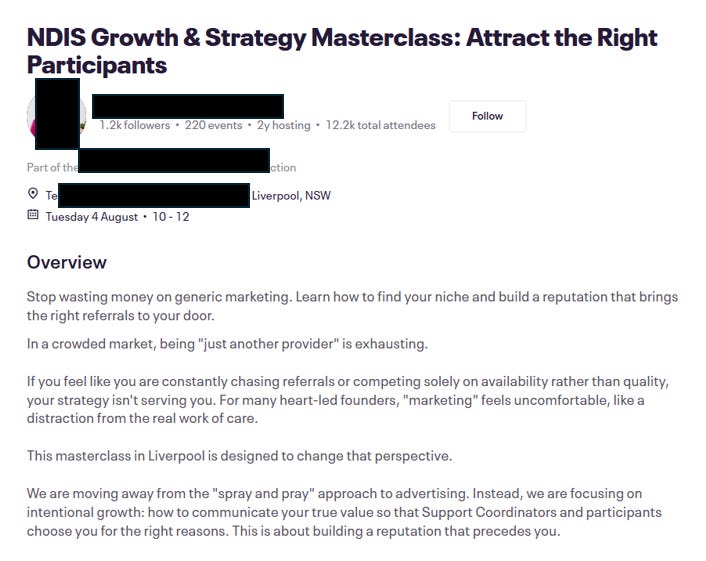
They will register an ABN, brand themselves as a support coordinator or a therapeutic assistant or a community participation specialist, and then go hunting for clients. Or they will convince a client to go hunting for them.
The difference between unemployment benefits and becoming an NDIS provider is not subtle. Unemployment benefits are means tested and capped. They are designed to provide basic support but also to motivate re-entry into productive work.
NDIS provider income is none of those things. You can charge $70 an hour to take someone to the movies. You can charge $70 an hour to take someone for a walk. The scheme is not means tested on the provider side. There is no ceiling that bites.
So the rational response to unemployment, in this environment, is not to find a more productive job. It is to find a disabled person. Or, as Reddit will helpfully explain if you go looking, to help someone discover that they or their children qualify for support they were previously unaware of.
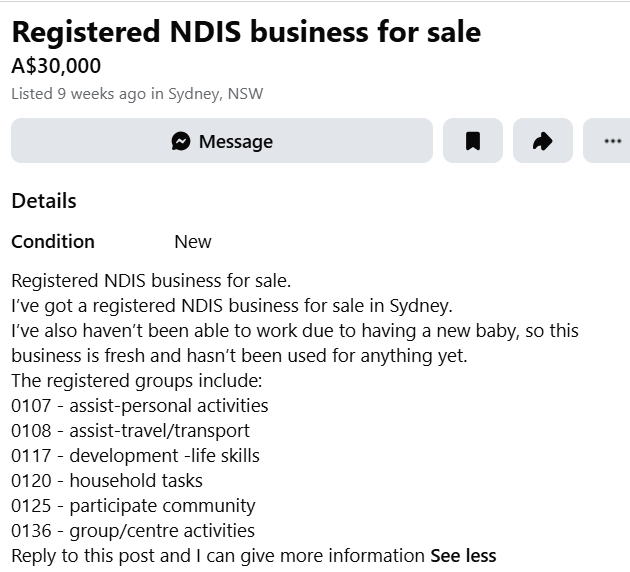
The market has noticed. Search for NDIS businesses for sale and you will find a cottage industry of shell providers, registered and ready, with no clients attached, listed on social media market sites.
None of this is to suggest that people with genuine disabilities do not deserve support. They do. The problem is that when a support scheme becomes the primary mechanism by which a country absorbs its unemployed and insulates itself from economic correction, it has stopped being a disability scheme and started being something considerably stranger.
Australia has not avoided the recession. It has just made it invisible, expensive, and permanent.